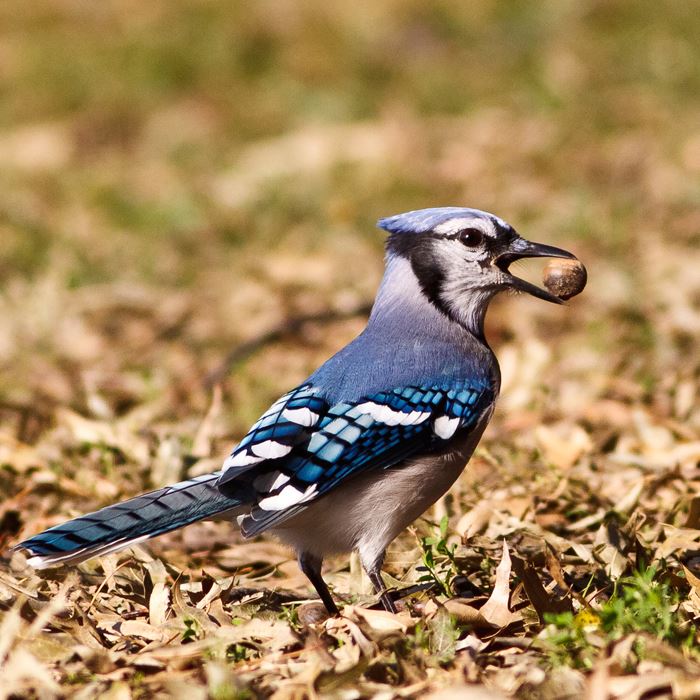
I love Blue Jays. I really do.
Yesterday morning, I saw about five of them join a few crows in sounding the alarm to let others know our resident Cooper’s Hawk (the reason my feeders are down) was about. That’s a great neighborhood service, isn’t it? I mean, not for Cooper because it’s been a rough winter and I’m sure he’s hungry, but the little birds appreciate the heads up.
Blue Jays are just so fun and interesting. Their feathers are not blue; they’re brown – it’s a trick of the light! They are very dedicated parents. They are excellent mimics. And, my favorite one: a single Blue Jay can bury up to 4,500 acorns each fall to eat later in the winter – that’s good planning ahead!
Now here’s the thing: they remember where only about a quarter of those acorns are buried, which means they end up planting more than three thousand oak trees every year. That is amazing and awesome and we need to be more like them. Yes, I know, we can’t plant thousands of oaks every fall, but how about we start with one, two, or three? Yes, that’s right, I am here today to talk to you about oak trees.
Oaks are the most important native plant species in most of North America. They are great at sequestering carbon and pumping that carbon into the soil (great for humans who like breathing); they’re great at managing the watershed (especially important for us on the Cape); and they’re great at capturing the energy from the sun and turning it into food that supports hundreds of species of animals. Aside from supporting the aforementioned Blue Jays, plus squirrels, chipmunks, woodpeckers, etc., on the Cape, our native oaks are host plants for 473 species of moths and caterpillars, many of which perform pollination services or end up as dinner for our resident backyard birds like Tufted Titmice, Black-capped Chickadees, Northern Cardinals, Eastern Bluebirds, and more, who NEED caterpillars to rear their young. Little hatchlings cannot eat bird seed – only caterpillars, and a lot of them.
So, if you are looking for a native plant that is best at providing clean air, clean water, healthy soil, and food for birds and other wildlife, look no further – PLANT AN OAK!
Think you don’t have room for an oak? Think again! There are eight species of oaks native to Cape Cod that come in different sizes, and if the smallest one is still too big for your yard, you can use the ancient technique of coppicing anytime from fall through late winter to make it into a “shrub.” It will not reach maturity and make acorns, but it will still provide a lot of ecological value to your yard, including hosting hundreds of insects. “When your tree reaches a diameter of at least 2-3 inches, cut it off about 12 inches from the ground. Your stump, or stool, will sprout new growth the following spring. When it does, you have created a copse, which can be cut again and again, indefinitely.” – Douglas W. Tallamy, How Can I Help? Saving Nature with Your Yard.
These are our Cape Cod native oaks in order of size from small to large:
- Quercus prinoides (dwarf chestnut oak, dwarf chinkapin oak)
- Height 12-25 ft
- Spread 12-25 ft
- Sun, part shade
- Average, dry
- Yellow to orange fall foliage


- Quercus ilicifolia (scrub oak, bear oak)
- Height 3-30 ft
- Spread 3-30 ft
- Sun
- Average, dry
- Red, purple, orange to brown fall foliage


- Quercus coccinea (scarlet oak)
- Height 50-70 ft
- Spread 25-40 ft
- Sun, part shade
- Average, dry
- Red to purple fall foliage


- Quercus stellata (post oak)
- Height 30-50 ft
- Spread 35-50 ft
- Sun
- Average, dry
- Red to brown fall foliage


- Quercus vetullina (black oak)
- Height 50-60 ft
- Spread 50-60 ft
- Sun
- Average, dry
- Red to purple fall foliage


- Quercus bicolor (swamp white oak)
- Height 60-80 ft
- Spread 30-40 ft
- Sun, part shade
- Wet, average
- Red, purple, and yellow to bronze fall foliage


- Quercus alba (eastern white oak, northern white oak)
- Height 60-80 ft
- Spread 30-40 ft
- Sun, part shade
- Average, Dry
- Species Red to purple fall foliage


- Quercus rubra (northern red oak)
- Height 60-80 ft
- Spread 30-45 ft
- Sun, part shade
- Wet, average
- Red to purple fall foliage


The reason I am telling you this now, in February, is that I want you to start thinking about where you can grow a new oak, even if it is just in “shrub” form. The great news? Planting an oak can be surprisingly easy and even free because they are best grown from acorns. So, your homework for this next spring and summer is to figure out which oak you would like to plant, and where you can plant it. Actually, oaks grow better when planted in groves, so think about planting maybe two or three of them at the same time – their roots will be much stronger together. Then find a mature tree and remember to come back in the fall to collect acorns. Please make sure you have permission to collect if you’ll be venturing into private property, though. Different species will have different requirements for germinating – I will have that information ready to go long before fall so you can be ready. Please check back or reach out later.
If you want to know more about planting an oak, there’s a great short chapter about it in the back of Douglas W. Tallamy’s book, The Nature of Oaks: The Rich Ecology of Our Most Essential Native Trees. This, along with lots of more great information about the mighty oak can be found in this book, which you can borrow for free through your nearest CLAMS library.
For those of you who are looking for instant gratification and don’t want to “wait” for their tree to grow and think you can just buy a tree sapling or an expensive large tree to plant, think again. Professor Tallamy highly discourages people from doing so because those trees have a hard time adjusting to their new homes and many of them just don’t make it. However, if you still want to give it a shot and want to buy an oak sapling on (or actually near) the Cape, here are a few places you can check out:
- Native Plant Trust’s Annual Plant Sale
- Blue Stem Natives
- Grow Native Massachusetts Native Plant Sale
In the last year, I have been noticing that people have been cutting down trees (including old, mature oaks) for unnecessary reasons like… being tired of raking leaves. I’ve also seen properties completely wiped out of trees so people can get more sunlight on their roofs to install solar panels*. This, plus more human activities round the country leads to deforestation and fragmentation, which leads to fewer trees in general, including oaks.
The moral of the story is this: fiercely protect your existing oaks if you are lucky enough to have some on your property and also….. just plant more oaks. Jays have been doing it for about 60 million years having evolved at the same time as oaks. They are responsible for planting many of the great oak forests in North America. Now we are responsible for destroying them. We can’t have that. What kind of legacy are we leaving here? No. We can be fierce. We can be loud. We can be bold. We can plant oaks too.
We can be Blue Jays.

*I am personally appalled whenever I see that several or most of the trees have been taken down from a property to install solar panels. I see it often and it’s been happening more and more. The argument is that solar panels will help with carbon emissions and will offset cutting down trees. I am a big proponent of solar panels and renewable energy in general, but I find it suspicious that all the literature I can find on whether this is a good idea is coming from the solar companies themselves who are saying that, when given a choice, having solar panels will be better than having the trees. I guess, if the only factor is CO2 emissions vs carbon sequestration, maybe they’re right (maybe), but what about the other benefits mature trees provide? Are solar panels contributing to soil health and stabilization, helping manage the watershed, providing cover for wildlife and transferring energy up the food web? Jury’s still out.
Leave a Reply