“The only thing that you absolutely have to know is the location of the library,” said Albert Einstein.
This has pretty much been the motto by which I’ve lived my life since I got my first library card at sixteen. I am a little bit intense (in case you haven’t figured that out yet), and when I get interested in a topic, I become a little bit obsessed and always must learn more! Libraries have fed my curiosity and bolstered my growth by giving me access to a never-ending supply of books, no matter what topic I’m into. I love books and libraries so much that I actually became a librarian.
My latest obsessions are birds, native plants, and conservation at home. In my short journey so far, I’ve found several books on these topics that I truly love and find valuable. I’ll do a list of bird books in the near future, but today, I want to share books about native plants and building habitat at home and invite you to use your library card to check them out at one of the 38 libraries on the Cape. Don’t have a CLAMS card yet? Click here to sign up for one online.
Without further ado, here’s the list:


If you are at all interested in learning about native plants and don’t yet know Doug Tallamy, you really need to. He is the face of the native plant movement and the mind behind Homegrown National Park—an initiative that asks us all to take matters into our own hands and restore habitat for our local wildlife and ourselves wherever we can. He clearly explains why this is necessary and lists the concrete steps to accomplish it. Some of these include: shrinking the lawn, removing invasive species, planting keystone and pollinator species, and creating caterpillar landing sites under your trees.
We can ACTUALLY do this. We can.
Three years ago, I was not even a gardener. Now, I have a bunch of winter sowing containers on my picnic table full of seeds and—already—tiny little sprouts that will become a lifeline for a bee, a butterfly, or a bird in my yard. Professor Tallamy always starts his talks about this book the same way: “I wrote a book called Nature’s Best Hope, and the spoiler is YOU are Nature’s Best Hope.”
I’ve taken that to heart… I hope you will too.
Request a copy from a CLAMS library here.
As a bonus, there is a Young Reader’s Edition available, too. You can request a copy of that version here.


This book was written specifically for you and me—Cape Codders! If you can only read one book, read this one. It is short, sweet, and to the point.
The tips explained here are easy to implement, from adopting eco-land care practices like avoiding fertilizers and pesticides, to collecting rainwater, and, of course, adding native plants. The book also includes plenty of local resources to help you put those tips into practice.
My favorite quote is about embracing a Cape Cod lawn: “You have permission to have a Cape Cod lawn because, after all, you live on Cape Cod, and aren’t there better ways to spend your time and money?” If that is not a convincing argument, I don’t know what is.
Request a copy from a CLAMS library here or better yet, if you can afford it, buy a copy from APCC – it supports their efforts!
3. Native Ground Covers for Northeast Landscapes by Wild Seed Project


Based in Maine, the Wild Seed Project is a wonderful organization that works to promote conservation and restoration in the Northeast. This cute little book is jam-packed with useful information and ideas on how to replace your lawn (are you sensing a theme here?) and which plants you might choose depending on your growing conditions.
It features more than 35 plant profiles that include the usual sun and water requirements, plus growth rate information. My favorite part is the guild descriptions, which suggest combinations of companion plants that grow well together in different conditions. These pairings have a better chance of “creating dense, layered and diverse plantings that delight and inspire.”
Request a copy from a CLAMS library here.
4. Native Shrubs for Northeast Landscapes by Wild Seed Project


Ah! How lucky are we? There isn’t just one book in this series—there are three!
This one is about shrubs, the most important native plants in your landscape after trees. If you’re looking to add spring sources of nectar and pollen for your local pollinators, you need to look into native shrubs, as many of them are the first to bloom. Although, they truly are landscape powerhouses the whole year though. As the book says, “native shrubs create a woody plant layer between native trees and ground covers that is vital to supporting pollinators, birds and other wildlife year-round.”
The coolest part of the plant profiles in this book is the growth form information. Each profile includes a visual icon so you can see if the shape will be mounded, suckering, vase-shaped, irregular, or tree-like in your yard.
Request a copy from a CLAMS library here.
5. Native Trees for Northeast Landscapes by Wild Seed Project


This is the most important book of the Wild Seed Project trio because trees are our most important native plants. They provide shade and erosion control, stabilize the soil, trap tons of carbon, and filter water with their deep roots. Perhaps best of all, they are rockstars at providing habitat for our local wildlife by producing caterpillars—the “little things that run the world.”
In case you don’t know, the best tree of all for our region is in the genus Quercus: the mighty oak. I wrote a whole blog about it, so no need to get into it again, but the point is: they add enormous value to our landscapes. Plant one or two if you can.
In this book, plant profiles are divided by tree size (small, medium, and large), making them easier to browse and imagine in your yard. Aside from the usual sun and moisture requirements, each page also includes a form/size illustration at the bottom, as well as growth rate and life span information. Lastly, there is a small section with advice and instructions for planting trees from seed, which actually makes them more likely to adapt and succeed once planted than buying and planting large trees.
Request a copy from a CLAMS library here.
6. Native Plant Gardening for Birds, Bees & Butterflies (Northeast) by Jaret C. Daniels (2022)


This is a great book for those who want to focus their efforts on providing pollinator habitat. The first four sections are “Why You Should Plant a Garden,” “The Basics of Plant Anatomy,” “Why Protect Pollinators?,” and “Meet the Pollinators.” These sections are short and sweet, offering a great starting base before you get to the plants, which are sorted by sun requirements (full sun, full sun to partial shade, and partial shade to full shade). The plant profiles have just the right amount of detail and feature gorgeous full-color pictures.
The last section has plant lists specific to some of the pollinator groups and their needs: butterflies, bees, bird food & nesting, hummingbirds, and larval host plants. While most of the plants listed in this book are native to the Northeast, they are not all native to Barnstable County, so if that’s important to you, be sure to cross-reference with my plant profiles or by visiting Native Plant Trust’s Go Botany. Keep in mind, though, that even if they are not all native or near-native, all these plants provide great ecological value to the landscape and to pollinators.
Request a copy from a CLAMS library here.


This book was written by Uli Lorimer, Director of Horticulture for the Native Plant Trust, a leading nonprofit dedicated to preserving the native flora of the Northeastern United States. The first two chapters provide a great, easy-to-digest introduction to native plants, why we need them, and how to get started with using them in the landscape.
The plant profiles are divided into trees, shrubs, vines, wildflowers, ferns, grasses, and annuals, which is super helpful. While the information for each plant isn’t always extensive (there isn’t much on specific growing requirements), the images are so beautiful they’ll give you a great idea of whether you want to dive deeper into a specific species.
Note that this book covers plants native to the Northeast, which has plenty of overlap with us here on the Cape, but keep that in mind if your “native” focus is a bit narrower. The plants featured here all provide high ecological value, but if they aren’t specifically native to Barnstable County, they might not adapt quite as easily – that’s all. If you’re looking for native plant inspiration – or just inspiration in general – get this book.
Request a copy from a CLAMS library here.
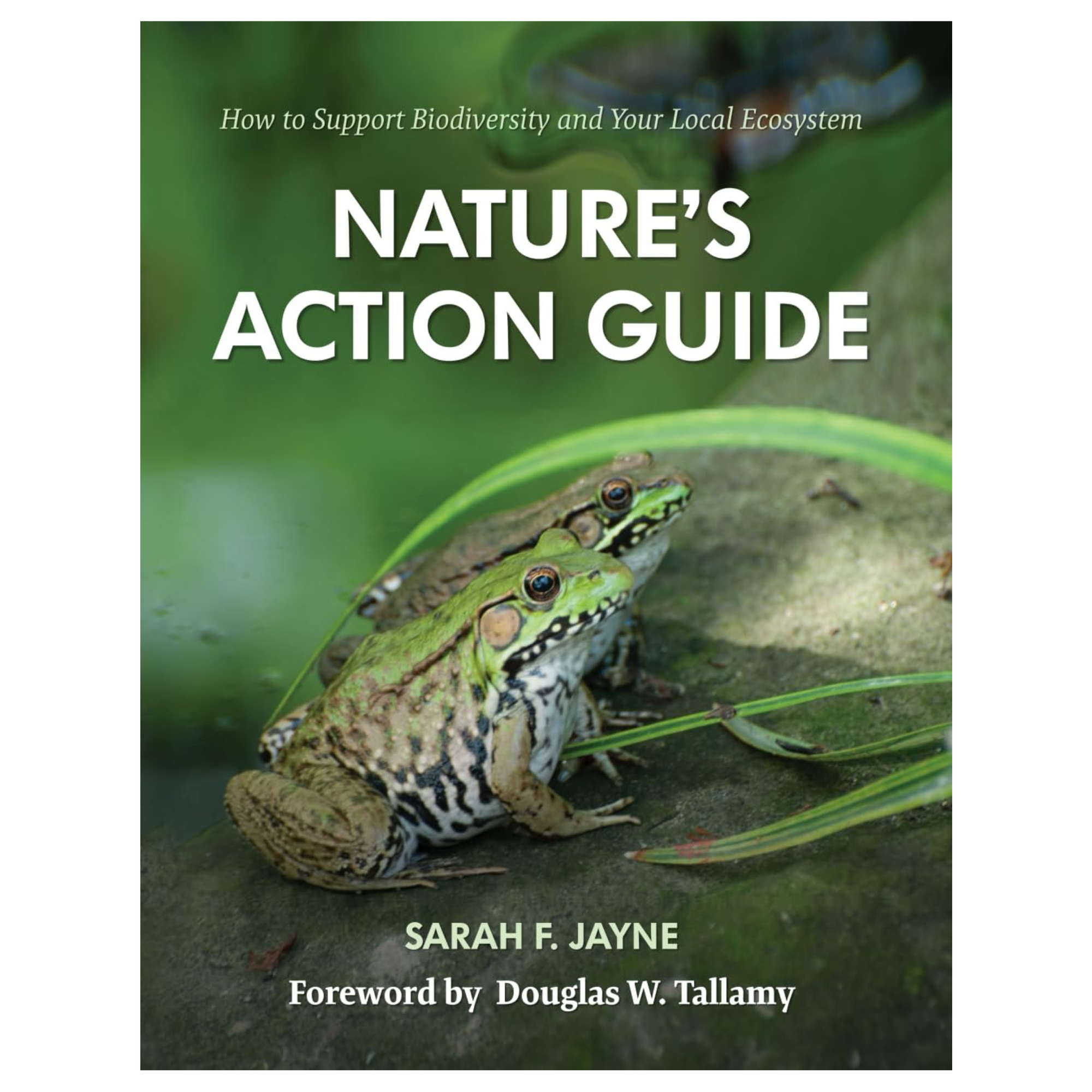
8. Nature’s Action Guide: How to Support Biodiversity and Your Local Ecosystem by Sarah F. Jayne (2024)


This book is an absolute treasure trove of helpful information. All the things conservationists—and specifically Doug Tallamy—have been talking about are listed here, with clear blueprints on how each action can be achieved. The tips and photos/illustrations are fantastic, and everything is presented in a way that is easy to follow.
From turning off the lights to protect insects, to shrinking the lawn, to propagating keystone plants, this book has it all and it’s broken down into such great details! Professor Tallamy even wrote the foreword, noting: “Nature’s Action Guide is current, explaining state-of-the-art conservation in suburbia with the most up-to-date best practices available. Even a half-hearted attempt to follow Sara’s action items is guaranteed to improve the biodiversity potential of your landscape and thus the productivity of your local ecosystem.”
I cannot recommend it enough. Request a copy from a CLAMS library here.


I’m sure you’ve heard of ways you can help the environment: cut back on meat and dairy, recycle, compost your food waste, fly less, and so on. But did you know that shrinking your lawn can also make a big impact? Owen Wormser, a sustainable landscape designer based in Western Massachusetts, explains it all in his wonderful book, Lawns into Meadows: Growing a Regenerative Landscape.
Why does maintaining a lawn matter? Because it’s not just one lawn here and there. Combined, the amount of turf in the US totals more than 63,000 square miles—about the size of Washington State! That’s a lot of fertilizer, a lot of pesticides, a lot of gas emissions from mowers, and worst of all, A LOT of water. Wormser writes, “Landscape irrigation is estimated to account for nearly one third of all residential water use, totaling nearly nine billion gallons per day or almost 13,000 Olympic-sized swimming pools worth of water.” That is mind-blowing and incredibly appalling.
It’s not all bad news, though. Wormser lays out a clear guide for turning some (or all—wink, wink) of your lawn into a meadow. He covers everything from site prep and plant profiles to upkeep, complete with beautiful full-color before-and-after photos of his projects in the back of the book. The last section even features answers to common questions like, “What about ticks?” “What if invasive or aggressive species appear in my meadow?” and “What else can I do to support meadows?”
Request a copy from a CLAMS library here.
10. The Nature of Oaks: The Rich Ecology of Our Most Essential Native Trees by Douglas Tallamy


Well… it started with Doug Tallamy and, not coincidentally, it ends with Doug Tallamy. What can I say? He’s a rockstar in this field.
In The Nature of Oaks, we spend a year with Professor Tallamy as he shares the amazing things happening around—and because of—oak trees. I loved reading about his journey of planting an oak from an acorn in 2000 and watching it grow in only 18 years to be “nearly 45 feet tall with a trunk circumference of 47 inches at breast height and a canopy spread of 30 feet.”
Aside from learning that oaks are even more incredible than some of us give them credit for, we also learn about their decline and what a huge problem that is for every living creature on the planet—including us. He writes, “Over a million species are headed for extinction in the next few years unless we take immediate action (Sartore 2019). We have no choice but to prevent such losses, not because we’re nice guys, but because it is those species that run the ecosystem that supports us. And by “we,” I mean every single human earth dweller, not just the surprisingly few people who already recognize the necessity of sustainable earth stewardship… it is the loss of common kingpins like oaks that we must prevent as if our well-being depends on them. For it does.”
As a bonus, there are sections at the end of the book on how to plant oaks and which options are best for your region. For more information on which oaks are native to Barnstable County, check out my blog on oaks.
Request a copy from a CLAMS library here.
Ok. That’s my humble list. I hope you feel inspired to check out some of these books—remember, if you do it through the library, it’s free! If you’ve read some of them already, which one is your favorite?
Also, don’t forget to follow me on Instagram and Facebook, where I’ll be posting photos and videos of native plants as the season progresses. My little winter sowing babies are starting to come up already!
Happy Spring (finally!) and happy native plant garden planning!
Leave a Reply